Phones don't stop ringing just because a team is busy, short-staffed, or closed for the night. Calls come in asking about business hours. Customers want to reschedule an appointment. A lead who filled out a form last week still hasn't gotten a callback. Support lines fill up with the same handful of questions, over and over, while more complex issues wait in the queue behind them.
None of this is a staffing failure; it's just what happens when call volume and predictability outpace the hours in a day. That's the specific gap AI voice agents are built to close: software that can hold a real spoken conversation, understand what a caller needs, and complete a defined task, without waiting for a person to pick up.
This article walks through 10 practical ways businesses are using AI voice agents to automate customer calls, with realistic examples, not just a list of buzzwords.
How Can Businesses Use AI Voice Agents?
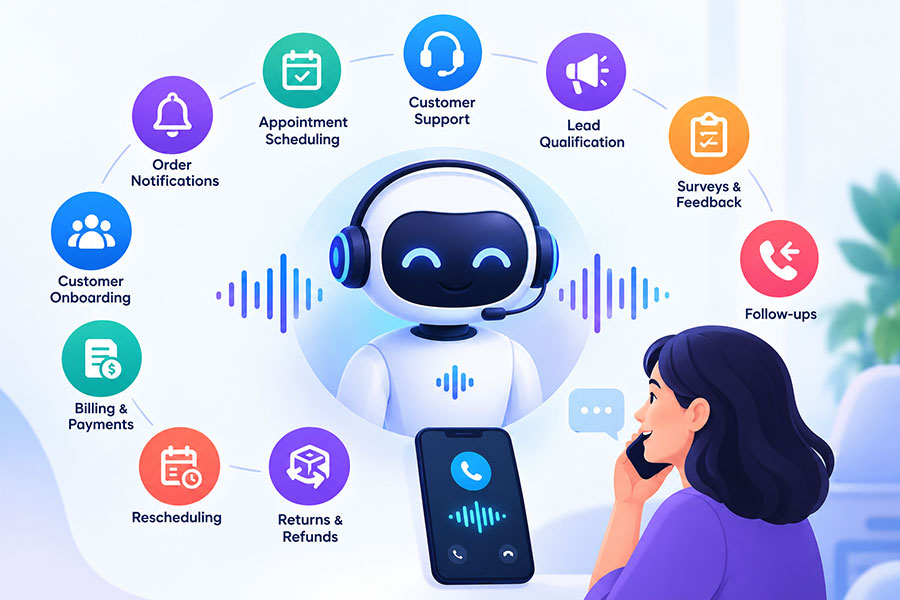
Businesses use AI voice agents to handle defined inbound and outbound conversations, answering customer enquiries, scheduling appointments, qualifying leads, following up with prospects, sharing order or status updates, sending reminders, answering FAQs, routing calls, supporting bookings, and handling routine customer service requests.
The common thread across all of these is structure. AI voice agents work best on conversations that follow a predictable pattern, even if the exact words a caller uses vary each time.
What Is an AI Voice Agent?
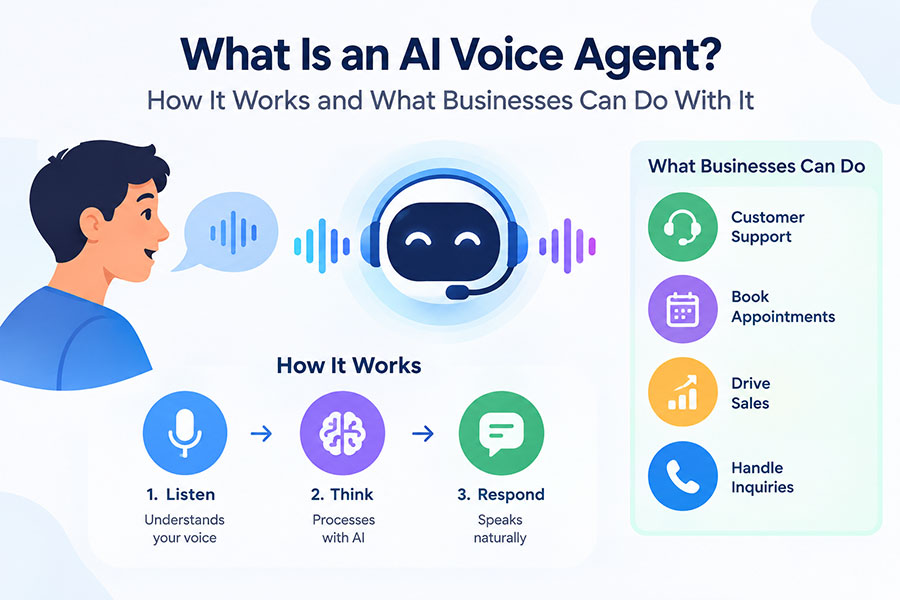
An AI voice agent is software that communicates with people over phone calls, understands spoken language, responds conversationally, and performs predefined business actions, like booking an appointment or looking up an order, without a human handling the call directly.
It's worth quickly distinguishing it from a few things people often confuse it with. It's not traditional IVR, which relies on fixed menus and keypad input rather than natural speech. It's not a basic automated phone system that just plays a recording. It's not a chatbot, which operates through text rather than voice. And it's not a replacement for every human call agent, it's built to take on the repetitive, structured share of the workload.
How Does AI Voice Call Automation Work?
AI voice call automation works by converting a caller's speech into text, using AI to understand their intent, checking relevant business information or workflow rules, performing an action, and responding in natural-sounding speech, all during the live call.
Here's the basic sequence:
- A customer calls in or receives an outbound call.
- Speech-to-text converts their spoken words into text.
- The AI identifies intent and keeps track of context.
- The system checks relevant business information or workflow rules.
- It performs the appropriate action, checking a calendar, pulling a record, and so on.
- Text-to-speech turns the response into natural speech.
- The conversation continues, with context carried forward.
- The call transfers to a human when the conversation calls for it.
Customer → Phone Call → Speech Recognition → AI Understanding → Business Logic → Action/Integration → AI Response → Human Handoff if Needed
10 Ways Businesses Can Use AI Voice Agents to Automate Customer Calls
1. Answer Customer Questions
What it automates: AI voice agents can handle repetitive customer questions, business hours, services offered, pricing information, locations, availability, basic policies, and general product information, using approved business information as the source.
How it works: The agent is given a defined set of approved answers, drawn from business documentation. When a caller asks a common question, the AI matches the intent and responds directly. If a question falls outside what it's been given approved information for, it can say so and route the caller appropriately rather than guessing.
Example conversation: Customer: "What time do you close on Saturdays?" AI Voice Agent: "We're open until 6 PM on Saturdays. Is there anything else I can help you with?"
Best for: Any business fielding a high volume of repetitive general enquiries, retail, restaurants, service businesses, clinics.
Business value: Frees staff from repeating the same answers dozens of times a day and gives callers an instant response instead of hold time.
2. Appointment Scheduling and Reminders
What it automates: AI voice agents can schedule, confirm, reschedule, and cancel appointments where supported, and place reminder calls ahead of a scheduled visit.
How it works: When a caller requests an appointment, the AI checks a connected calendar for availability, offers open time slots, confirms the customer's choice, and books it. For reminders, the AI places an outbound call ahead of the appointment, confirms the customer still plans to attend, and can offer to reschedule on the spot if needed.
Example conversation: Customer: "I need to reschedule my appointment from Thursday to Friday." AI Voice Agent: "I can help with that. I have Friday at 2 PM or 4:30 PM available, which works better for you?"
Best for: Healthcare practices, salons, professional services, education providers, and home services businesses.
Business value: Reduces manual scheduling work and helps cut down on missed appointments, without claiming any specific medical outcome or guarantee.
3. Lead Qualification
What it automates: AI voice agents can ask a predefined set of qualifying questions, covering budget, location, product interest, timeline, or service requirements, to assess whether a lead is a good fit before a sales rep gets involved.
How it works: When a prospect calls in or is reached through an outbound call, the AI asks structured questions in a natural conversational flow. The answers are captured and, where integrations are available, passed directly into a CRM or sales workflow for the right rep to follow up.
Example conversation: Customer: "I'm looking for a two-bedroom apartment under $300,000." AI Voice Agent: "Got it. Do you have a preferred neighborhood or area in mind?"
Best for: Real estate companies, financial services, insurance providers, and B2B sales teams.
Business value: Ensures sales reps spend time on leads who've already answered the basic qualifying questions, instead of starting every call from zero.
4. Outbound Lead Follow-Ups
What it automates: AI voice agents can make structured follow-up calls after a website enquiry, form submission, demo request, property enquiry, or other lead source, keeping prospects engaged without relying on manual dialing.
How it works: The AI places a call at a defined interval after the initial enquiry, references the original request, and asks a short set of follow-up questions or offers next steps, such as scheduling a call with a rep.
Example conversation: AI Voice Agent: "Hi, this is a follow-up on the pricing enquiry you submitted for our software last week. Do you have a few minutes to go over some options?" Customer: "Sure, go ahead."
Best for: SaaS companies, real estate businesses, financial services, and any business with a steady inbound lead flow.
Business value: Reduces the number of leads that go cold simply because no one had time to call back. It's worth noting the difference between useful, expected follow-up and unwanted repetitive calling; good workflows respect how many times and how often a lead is contacted.
5. Customer Support and Status Enquiries
What it automates: AI voice agents can handle routine questions about order status, appointment status, delivery information, booking details, basic account enquiries, and simple troubleshooting steps.
How it works: When a caller asks about the status of something, the AI verifies the caller's identity or reference details, checks the connected system, and reports back. This depends heavily on integrations; an AI voice agent without access to real order or account data can only offer general information, not a specific status.
Example conversation: Customer: "Where is my order? It was supposed to arrive yesterday." AI Voice Agent: "Let me check that for you. Your order shipped and is currently showing as out for delivery today by end of day."
Best for: Retail and e-commerce, logistics companies, financial institutions, and any business with frequent status-related calls.
Business value: Gives customers an immediate answer to a common question without waiting on hold, while keeping human support available for anything more complex.
6. Order and Reservation Handling
What it automates: AI voice agents can take restaurant orders, handle reservation and booking enquiries, collect pickup requests, and answer basic order or availability questions.
How it works: The AI walks the caller through the relevant details, what they'd like to order, pickup or delivery time, party size for a reservation, confirms the details back to the customer, and passes the completed order or booking into the business's system.
Example conversation: Customer: "I'd like to place an order for pickup at 7 PM." AI Voice Agent: "Sure, what would you like to order, and can I get a name for the pickup?"
Best for: Restaurants, cafes, and hospitality businesses with high call volume around ordering and bookings.
Business value: Frees staff working the phone during peak hours to focus on customers physically in front of them.
7. Call Routing and Human Handoff
What it automates: AI voice agents can identify the reason for a call, collect initial information, and route the caller to the right department, while escalating complex or sensitive conversations to a human.
How it works: At the start of the call, the AI asks what the caller needs, gathers relevant context, and either resolves the request directly or transfers it, along with a summary of what's already been discussed, to the appropriate team.
Example conversation: Customer: "I have a billing dispute I need to sort out." AI Voice Agent: "I understand, that needs a specialist on our billing team. I'll connect you now and pass along what you've told me so you don't have to repeat it."
Best for: Any business with multiple departments or a mix of simple and complex call types, telecom, financial services, larger retail operations.
Business value: Reduces the time callers spend explaining their issue multiple times, and ensures complex or sensitive situations reach a person who can actually resolve them.
8. Reminders, Confirmations, and Notifications
What it automates: AI voice agents can place outbound calls for appointment reminders, booking confirmations, event reminders, service reminders, and other customer notifications.
How it works: The AI places a scheduled call ahead of an event, states the relevant details, and confirms the customer's response, whether that's confirming attendance, requesting a reschedule, or acknowledging the notification.
Example conversation: AI Voice Agent: "This is a reminder about your service appointment tomorrow at 10 AM. Would you like to confirm, or do you need to reschedule?" Customer: "I'll confirm, thanks."
Best for: Healthcare providers, salons, service businesses, and any business where no-shows create real operational cost.
Business value: Cuts down on missed appointments and gives customers an easy way to respond. Outbound calling like this should be designed around appropriate customer consent and applicable calling regulations. This article isn't offering legal advice, so businesses should confirm requirements with their own counsel or compliance team.
9. Customer Feedback and Surveys
What it automates: AI voice agents can conduct short, structured conversations to collect customer feedback, satisfaction survey responses, post-service questions, or basic customer research.
How it works: After a defined trigger- a completed service, a recent purchase, an event, the AI places a brief outbound call, asks a small number of structured questions, and records the responses for analysis.
Example conversation: AI Voice Agent: "Thanks again for visiting us this week. On a scale of 1 to 5, how would you rate your experience?" Customer: "I'd say a 4."
Best for: Any customer-facing business that wants structured feedback without relying on written surveys alone.
Business value: Makes it easier to collect consistent feedback at scale, giving teams a clearer picture of where service is working and where it isn't.
10. After-Hours and High-Volume Call Handling
What it automates: AI voice agents can provide automated call handling when a team is unavailable, when call volume spikes suddenly, or when customers call outside normal business hours needing basic information.
How it works: Outside business hours or during a surge in call volume, the AI can answer, provide relevant information, collect the caller's details, and either resolve the request directly or schedule a follow-up for when the team is available again.
Example conversation: Customer: "I know it's late, but can I get some information about your services?" AI Voice Agent: "Of course, I can help with that now, or take your details so someone can call you back first thing tomorrow. Which would you prefer?"
Best for: Any business with meaningful after-hours call volume or unpredictable spikes, healthcare, home services, e-commerce.
Business value: Ensures a caller gets some response instead of a busy signal or voicemail. It's worth being precise here: this isn't a claim of unlimited capacity or a guarantee of round-the-clock service in every configuration; actual availability depends on how the system is set up and deployed.
Use Case Summary
| Use Case | Example Task | Suitable Businesses | Inbound/Outbound |
|---|
| Answer Customer Questions | Hours, pricing, location enquiries | Retail, restaurants, clinics | Inbound |
| Appointment Scheduling & Reminders | Booking, rescheduling, reminder calls | Healthcare, salons, education | Both |
| Lead Qualification | Budget/location/timeline questions | Real estate, finance, insurance | Both |
| Outbound Lead Follow-Ups | Following up on form submissions | SaaS, real estate, finance | Outbound |
| Customer Support & Status Enquiries | Order/appointment status checks | Retail, logistics, finance | Inbound |
| Order & Reservation Handling | Taking pickup orders, reservations | Restaurants, hospitality | Inbound |
| Call Routing & Human Handoff | Identifying and routing call reasons | Telecom, financial services | Inbound |
| Reminders, Confirmations & Notifications | Appointment and booking reminders | Healthcare, service businesses | Outbound |
| Customer Feedback & Surveys | Post-service satisfaction calls | Any customer-facing business | Outbound |
| After-Hours & High-Volume Handling | Covering calls outside business hours | Healthcare, home services, e-commerce | Inbound |
How Different Businesses Can Use AI Voice Agents
Real estate, lead qualification, property enquiries, budget and location questions, site-visit scheduling.
Restaurants: orders, reservations, menu questions, customer enquiries.
Retail & e-commerce, order status, returns questions, product enquiries, customer support.
Finance & banking, routine enquiries, lead qualification, reminders, follow-ups.
Insurance: renewal reminders, lead qualification, routine enquiries, information collection.
Education, admission enquiries, course questions, counselling requests, follow-ups.
Travel & hospitality, booking enquiries, reservations, guest support.
Logistics, delivery enquiries, scheduling, status calls.
Salon & beauty, appointment booking, rescheduling, reminders, service enquiries.
Can AI Voice Agents Handle Both Inbound and Outbound Calls?
Yes. AI voice agents can answer inbound calls from customers and place outbound calls for follow-ups, reminders, and surveys, often through the same platform, so a business isn't managing two separate systems for each direction.
| Inbound Calling | Outbound Calling |
|---|
| Answer customer calls | Make scheduled calls |
| Handle enquiries | Lead follow-ups |
| Appointment booking | Appointment reminders |
| Customer support | Surveys |
| Order questions | Confirmations |
| Call routing | Customer re-engagement |
Outbound calling in particular should be designed around appropriate customer consent, clear business policies, and applicable calling regulations. The specifics vary by jurisdiction and industry, so this is worth confirming with legal counsel rather than assuming.
AI Voice Agent vs. Traditional IVR
| Factor | AI Voice Agent | Traditional IVR |
|---|
| Interaction | Natural language | Menu-based |
| Input | Spoken conversation | Keypad/commands |
| Intent understanding | AI-based | Predefined paths |
| Flexibility | Workflow dependent | Usually fixed |
| Personalization | Can use context/data | Generally limited |
| Human handoff | Yes | Yes |
| Automation | Conversational workflows | Menu routing |
| Analytics | Depends on platform | Depends on system |
IVR remains a reasonable choice for many businesses, especially for simple, well-defined routing. AI voice agents don't necessarily replace existing phone systems, they can complement them, handling the conversations that benefit from natural language while IVR continues to handle basic routing.
What Should AI Voice Agents Handle, and What Should Humans Handle?
AI voice agents are well suited to repetitive requests, structured workflows, routine questions, scheduling, lead qualification, follow-ups, and information collection. Human teams remain essential for complex issues, sensitive situations, exceptions, escalations, high-value customer relationships, and anything requiring real judgment.
Treating this as an AI-plus-human model, rather than a full replacement, tends to work better in practice. It keeps the AI focused on the volume it can genuinely handle well and keeps people focused on the calls where their judgment actually matters.
What Are the Benefits of Automating Customer Calls With AI?
- Faster response times for callers
- Fewer missed calls
- Reduced repetitive workload for staff
- More consistent customer communication
- Faster lead follow-up
- Automated scheduling and reminders
- Call handling that scales with volume
- Availability outside normal business hours
- More structured, trackable customer information
- Workflow automation tied directly to conversations
AI voice automation tends to work best when a business is clear and specific about what the agent should, and should not, handle.
Which Customer Calls Should a Business Automate First?
A practical way to decide is to evaluate calls against a few factors: frequency, repetition, predictability, business value, risk level, required integrations, and how much human judgment the conversation actually needs.
In general, businesses get the most value starting with high-volume, repetitive, clearly defined workflows, like appointment scheduling or answering common questions, before expanding into more complex or sensitive conversation types.
Where Does GrootVox Fit Into AI Call Automation?
GrootVox is an AI voice agent platform designed to help businesses automate real phone conversations and connect those voice interactions with everyday business workflows.
It's built around the categories of automation covered in this article: inbound and outbound calling, call automation and routing, lead qualification, appointment and booking management, customer support, follow-ups, enquiry handling, and order management, with analytics to track outcomes, multilingual support, integrations with existing business systems, and human handoff for anything that needs a person's attention.
A few illustrative examples of how that plays out:
Real estate: a lead calls in, the AI asks about budget, location, and preferences, qualifies the enquiry, captures the information, and schedules a follow-up or site visit.
Restaurant: a customer calls to place a pickup order or make a reservation; the AI collects the necessary details and passes them into the relevant system.
Salon: a customer calls asking for an appointment; the AI checks the booking workflow and schedules or reschedules accordingly.
Education: a prospective student calls asking about a course; the AI answers approved FAQs, captures the enquiry, and routes or schedules a follow-up.
These are illustrative workflows describing how the categories of automation covered in this article would typically apply, not a claim about specific, verified deployments.
How Much Does AI Voice Call Automation Cost?
Costs for AI voice call automation generally depend on factors like call minutes, call duration, the number of phone numbers in use, the voice provider and AI model, overall usage volume, required integrations, custom workflows, analytics, and support needs. Because these variables differ significantly between businesses, there's no single industry-wide figure to point to, and any specific GrootVox pricing should be confirmed directly based on actual use case and volume.
What Do You Need to Start Automating Customer Calls With AI?
- Define the specific use case you want to automate first
- Map out the conversation flow, what a caller might ask and how it should be handled
- Identify what business data or systems the AI will need access to
- Decide whether the workflow is inbound, outbound, or both
- Connect the required systems (calendar, CRM, order system, etc.)
- Define clear escalation rules for when a human should take over
- Test common, expected scenarios
- Test unexpected or edge-case questions
- Set up ongoing monitoring of live conversations
- Review conversation outcomes regularly
- Refine workflows over time based on what you learn
Frequently Asked Questions
- What can an AI voice agent automate? An AI voice agent can automate repetitive phone-based tasks like answering FAQs, scheduling appointments, qualifying leads, following up with prospects, taking orders, checking status information, routing calls, and sending reminders, as long as the workflow is clearly defined.
- How can businesses use AI voice agents? Businesses use AI voice agents to handle structured inbound and outbound conversations, from customer enquiries and appointment booking to lead qualification, order-related questions, and reminder calls, reducing manual workload on staff.
- Can AI voice agents handle inbound calls? Yes. AI voice agents can answer incoming customer calls, respond to enquiries, take orders, book appointments, and route callers to the right department when needed.
- Can AI voice agents make outbound calls? Yes. AI voice agents can place outbound calls for lead follow-ups, appointment reminders, confirmations, and customer surveys, generally guided by defined consent and calling policies.
- Can AI voice agents schedule appointments? Yes. When connected to a calendar system, an AI voice agent can check availability and book, reschedule, or cancel appointments directly during a call.
- Can AI voice agents qualify sales leads? Yes. AI voice agents can ask a structured set of qualifying questions, covering budget, timeline, or requirements, and pass the results to a sales team, often through a connected CRM.
- Can AI voice agents automate customer support? They can automate routine, repetitive support requests like order status or basic account questions. More complex or sensitive support issues generally still benefit from a human agent.
- Can AI voice agents take restaurant orders or reservations? Yes. AI voice agents can collect order details, confirm pickup or delivery times, and handle reservation requests, passing the completed information into the restaurant's system.
- Can AI voice agents replace human call agents? Not entirely. AI voice agents handle structured, repetitive conversations well, but complex, sensitive, or high-value conversations still generally require a human's judgment.
- How much does AI voice automation cost? Cost depends on factors like call volume, duration, integrations, and customization, so there's no single fixed price. It's best to get a specific estimate from a provider based on your actual usage needs.
Ready to Identify Your First AI Voice Workflow?
The businesses that get the most out of AI voice automation usually don't try to automate everything at once, they start with one clearly defined, high-volume workflow, like appointment scheduling or answering common questions, and expand from there.
If you're weighing which of your customer calls might be a good starting point, platforms like GrootVox let you explore that with a specific use case in mind rather than a blank slate. You can start a free trial, book a demo, or talk through a custom voice workflow with the GrootVox team to see what fits your call volume and existing systems.
 AI Insights