Phones still drive a huge share of business conversations, but most teams aren't set up to handle them well. Calls come in outside business hours. Support lines get flooded with the same five questions. Leads sit in a queue while someone finds time to call back. A front desk gets pulled away from patients or customers to answer a scheduling question for the third time that day.
This is the gap that AI voice agents are built to fill. Instead of routing callers through rigid phone menus or leaving them on hold, an AI voice agent can hold a natural conversation, understand what a caller needs, and take action in real time, booking an appointment, answering a question, or collecting information.
This article explains what an AI voice agent actually is, how it works, what it can realistically do for a business, and where a platform like GrootVox fits into that picture.
What Is an AI Voice Agent?
An AI voice agent is software that can hold spoken conversations with people over the phone, using speech recognition and conversational AI to understand requests and respond naturally. It can answer calls, make calls, understand what a caller wants, and complete tasks like scheduling, answering questions, or collecting information without a human on the line.
That's different from what most people picture when they think of "automated phone systems." An AI voice agent isn't reading from a fixed script or waiting for someone to press a number on a keypad. It listens to normal speech, figures out the intent behind it, and responds the way a person would while still being able to check a calendar, look up an order, or pull information from a business system mid-conversation.
It's also worth being clear about what an AI voice agent is not:
- Not traditional IVR. Old-style "press 1 for sales" systems rely on fixed menus and DTMF keypad input, not natural language.
- Not a basic voice assistant. Consumer assistants like general-purpose smart speakers are built for simple commands, not structured business workflows.
- Not a chatbot. Chatbots operate through text, usually on a website or messaging app, not over a phone call.
- Not a replacement for every human agent. It's built to handle structured, repetitive conversations, not every call a business receives.
How Do AI Voice Agents Work?
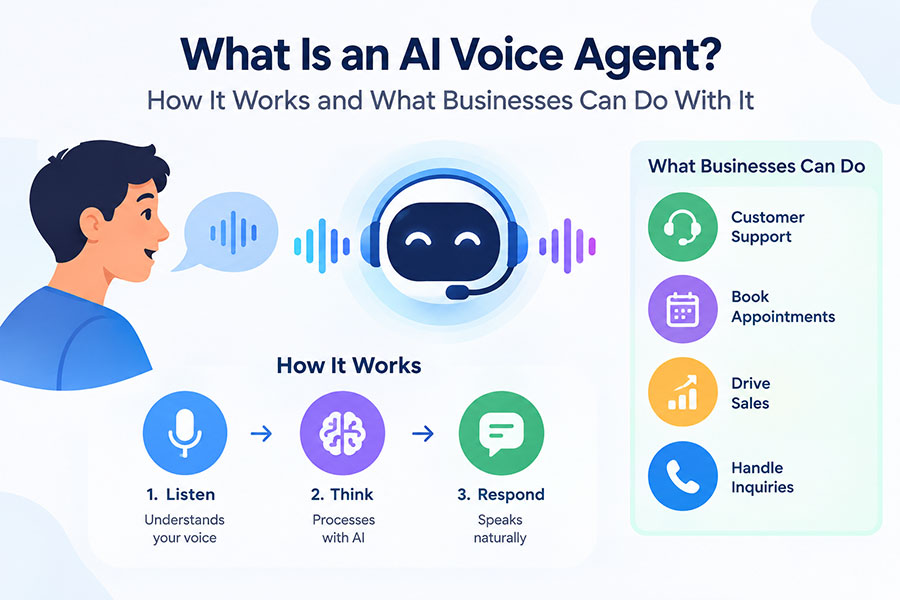
AI voice agents work by converting speech to text, using natural language processing to understand what the caller wants, checking connected business systems for relevant information, generating a natural-sounding response, and converting that response back into speech, all in real time during the call.
Here's what that process looks like in practice:
- A customer starts a call. This can be inbound (a customer calls the business) or outbound (the AI voice agent calls the customer for a follow-up, reminder, or qualification call).
- Speech recognition converts speech into text. Speech-to-text technology transcribes the caller's spoken words into text the system can process, in real time.
- AI understands the customer's intent. Natural language processing and large language models analyze the text to figure out what the caller actually wants not just the words they used, but the underlying request. The system also tracks context, so it doesn't lose track of what's already been said earlier in the call.
- The AI determines what to do. Based on business rules, connected workflows, and knowledge bases, the system decides what action fits the request, whether that's checking a calendar, pulling account information, or recognizing that the request needs a human.
- The AI generates a response. Conversational AI produces a natural-language reply based on the intent and the information available, rather than picking from a fixed list of scripted responses.
- Text is converted back into speech. Text-to-speech technology turns that response into audio that sounds like natural spoken language, not a robotic voice reading a script.
- The conversation continues. The AI maintains context through the rest of the call, so a caller can ask follow-up questions without repeating information they already gave.
- The AI completes an action or transfers the call. This might mean booking an appointment, qualifying a lead, answering a question, updating a record, taking an order, scheduling a follow-up, or, when the conversation goes beyond what the AI should handle, transferring to a human team member.
In short: Customer → Speech Recognition → AI Understanding → Business Workflow → AI Response → Voice → Customer.
How Does an AI Voice Agent Understand What People Say?
This part trips people up the most, so it's worth breaking down without the jargon. Say a customer calls and says:
"I'd like to schedule an appointment for Friday afternoon."
An AI voice agent processes that sentence by identifying a few key pieces:
- Intent: the customer wants to schedule an appointment
- Date: Friday
- Time preference: afternoon
- Required action: check availability for that time window and offer a slot
From there, the system checks a connected calendar, offers available times, confirms the customer's choice, and books the appointment all within the same natural conversation, without the customer needing to know any of this is happening behind the scenes.
What Can an AI Voice Agent Do for a Business?
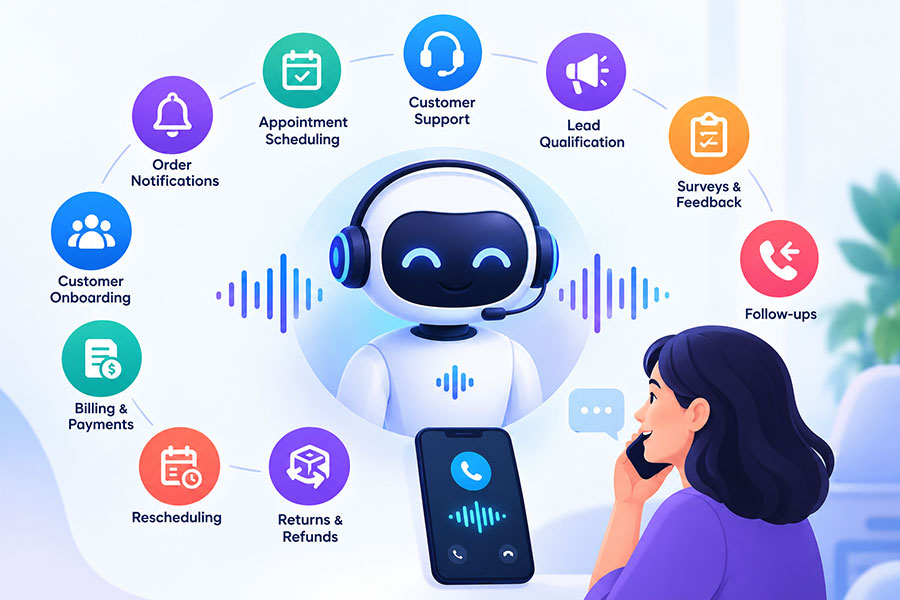
AI voice agents are built to handle the kinds of conversations that happen over and over, the same way, every day. Common capabilities include:
- Answering inbound calls, greeting callers, and handling their requests directly
- Making outbound calls for follow-ups, reminders, or qualification
- Qualifying leads: asking structured questions to assess fit before a rep gets involved
- Scheduling and rescheduling appointments: checking availability and booking in real time
- Sending reminders and confirmations: reducing no-shows and missed bookings
- Answering FAQs: handling common questions without tying up staff
- Collecting customer information: intake details, preferences, or account information
- Following up with leads: keeping prospects warm without manual dialing
- Handling enquiries: general questions about products, services, or availability
- Taking orders: capturing order details and passing them to the right system
- Checking status information: order status, application status, and similar lookups
- Routing calls: directing callers to the right team or department
- Conducting surveys: collecting structured feedback over the phone
- Handling routine support requests: the repetitive tier of customer service
- Triggering business workflows: updating a CRM record or kicking off a process automatically
- Transferring complex calls to humans when a conversation needs judgment the AI shouldn't handle alone
Real Business Conversations, Not Scripted Menus
What separates a useful AI voice agent from a basic automated system is whether it can connect a conversation to an actual business workflow, not just recognize a keyword and read back a canned response.
Real estate. A caller says: "I'm looking for a two-bedroom apartment under $300,000." A well-built AI voice agent can ask about preferred locations, confirm the budget, ask about must-have features, log the lead's details, and schedule a follow-up call or property visit.
Restaurants. A caller says: "I want to place an order for pickup at 7 PM." The agent collects the order details, confirms the pickup time, and passes the order into the restaurant's system.
Education. A caller says: "I want to know about your MBA program." The agent can answer common questions about the program, capture the caller's contact information, and flag the enquiry for the admissions team.
In each case, the value isn't the conversation itself; it's what happens because of it.
AI Voice Agent vs. Chatbot
AI voice agents and chatbots often get lumped together, but they solve different problems.
| Feature | AI Voice Agent | AI Chatbot |
|---|
| Interaction | Voice | Text |
| Phone Calls | Yes | Usually no |
| Natural Conversation | Voice-based | Text-based |
| Appointment Booking | Yes | Yes |
| Lead Qualification | Yes | Yes |
| Customer Support | Yes | Yes |
| Hands-Free Interaction | Yes | No |
| Best For | Phone conversations | Digital/text conversations |
These technologies aren't really competing with each other; many businesses use both, so customers can reach out by phone or by text depending on what's convenient for them at the time.
AI Voice Agent vs. Traditional IVR
Traditional IVR (the "press 1 for sales, press 2 for support" system) and AI voice agents both handle phone calls, but they work very differently.
| Factor | Traditional IVR | AI Voice Agent |
|---|
| Conversation Style | Menu-based | Natural language |
| User Input | Keypad presses | Spoken conversation |
| Intent Understanding | Limited, fixed options | Interprets varied phrasing |
| Flexibility | Low | Higher |
| Personalization | Minimal | Context-aware |
| Workflow Automation | Basic routing | Can complete full tasks |
| Human Handoff | Usually manual | Can be built into the flow |
| Customer Experience | Often frustrating | Closer to a natural call |
| Scalability | Limited by menu depth | Scales with conversation design |
| Analytics | Basic call logs | Conversation-level insights |
This doesn't mean every AI voice agent automatically outperforms every IVR system; a poorly designed AI voice agent can frustrate callers too. The difference is in the underlying capability: natural language understanding versus fixed menu logic.
What Business Tasks Can AI Voice Agents Automate?
Automation works best on tasks that are repetitive, structured, and predictable. A few categories where that shows up most:
Sales: lead qualification, lead follow-ups, outbound campaigns, appointment setting.
Customer support: FAQs, status enquiries, basic troubleshooting, call routing.
Operations: appointment reminders, confirmations, scheduling, notifications.
Customer experience: surveys, feedback collection, booking assistance, general enquiries.
HR: candidate screening, interview scheduling, candidate follow-ups.
The common thread is structure. Tasks with a clear, repeatable pattern automate well. Tasks that require judgment calls generally don't at least not without a human in the loop.
Which Industries Use AI Voice Agents?
AI voice agents show up across a wide range of industries, though the specific use cases vary by business:
- Real estate: lead qualification, property enquiries, site-visit scheduling
- Restaurants: orders, reservation enquiries, menu questions
- Finance & banking: routine enquiries, lead qualification, reminders
- Retail & e-commerce: order status, returns questions, product enquiries
- Education: admission enquiries, course information, follow-ups
- Travel & hospitality: booking enquiries, reservation support
- Logistics: delivery enquiries, scheduling, status calls
- Salon & beauty: appointment booking, rescheduling, reminders
- Human resources: candidate screening, interview scheduling
Not every industry has the same requirements. A restaurant may need an AI voice agent for orders and reservations, while a real estate business may need it to qualify leads and schedule property visits. What your AI voice agent should handle depends on your business, customers, and workflow.
Key Technologies Behind AI Voice Agents
A few core technologies work together to make this possible:
- Speech-to-Text converts spoken words into text
- Text-to-Speech converts written responses into natural-sounding audio
- Natural Language Processing (NLP) interprets meaning and intent in language
- Large Language Models (LLMs) generate context-aware, natural responses
- Conversational AI manages the overall flow and logic of a dialogue
- Intent Recognition identifies what a caller is trying to accomplish
- Context Management keeps track of what's already been said during the call
- APIs connect the voice agent to outside systems and data
- CRM Integration syncs caller and lead data with sales or support systems
- Business System Integration connects to calendars, order systems, or databases
- Knowledge Bases supply accurate answers to common questions
- Call Routing directs calls to the right destination
- Human Handoff transfers conversations to a person when needed
- Analytics tracks call outcomes and conversation performance
Where Does GrootVox Fit In?
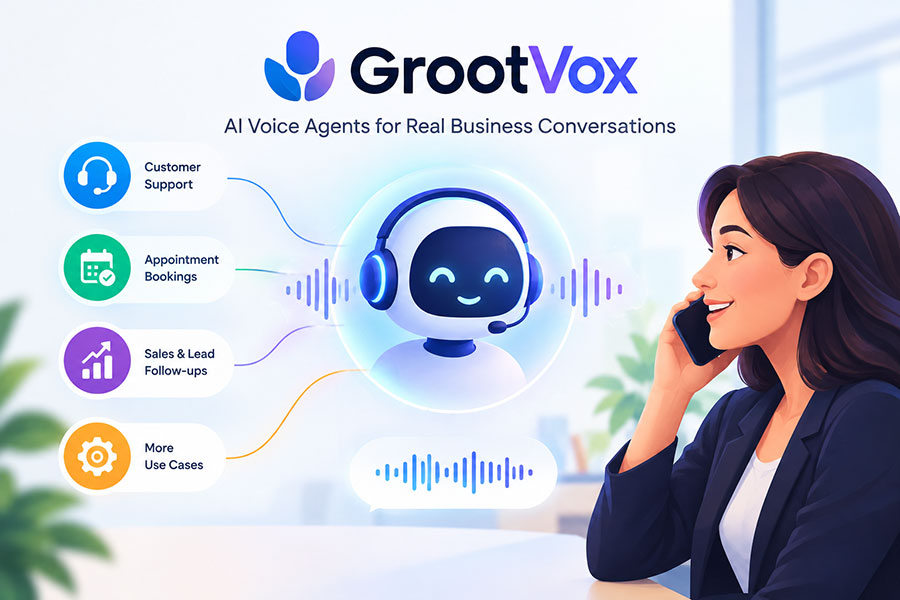
GrootVox is an AI voice agent platform designed to help businesses automate real phone conversations and connect those conversations to everyday business workflows: appointment booking, lead qualification, customer support, and follow-ups.
Rather than replacing a business's entire communication setup, GrootVox is built to handle the structured, repetitive side of phone-based work: inbound calling, outbound calling, call automation, call routing, enquiry handling, order management, and follow-ups, with analytics to track how conversations are performing and human handoff for anything that needs a person's attention. It also supports multilingual conversations and integrations with existing business systems, so voice interactions don't sit disconnected from the tools a team already uses.
How GrootVox Can Be Used
A few practical examples of how this plays out:
- A real estate company can use it to qualify incoming property leads before they reach an agent.
- A restaurant can use it to handle pickup and delivery orders along with customer questions.
- An education company can use it to answer course enquiries and capture prospective student information.
- A salon can use it to manage appointment scheduling and rescheduling without tying up front-desk staff.
The common pattern across all of these is the same: routine, structured conversations get automated, and the business decides where the human team picks up from there.
Can AI Voice Agents Replace Human Call Agents?
AI voice agents can automate repetitive, structured conversations, but they aren't a full replacement for human teams. Complex problems, sensitive conversations, high-value relationships, and situations that require judgment or empathy still benefit from a human on the line.
The most practical setup treats AI and human teams as complementary, not competing. AI handles the front line of routine requests, answering common questions, booking appointments, qualifying leads, and escalating anything more complex to a person. Human teams stay focused on:
- Complex or unusual problems
- Sensitive conversations
- Exceptions that don't fit a standard workflow
- High-value customer relationships
- Situations that require judgment or empathy
- Escalations that need a human decision-maker
This AI-plus-human model tends to work better in practice than trying to automate every single call, because it keeps people focused on the conversations where they add the most value.
Benefits of Using an AI Voice Agent
Businesses that adopt AI voice agents typically see practical, operational benefits rather than dramatic overnight change:
- 24/7 availability for routine calls
- Faster response times for callers
- Fewer missed calls and enquiries
- More consistent customer communication
- Reduced repetitive workload for staff
- Faster lead follow-up
- Call handling that scales with volume
- Automated scheduling and reminders
- Better visibility into call outcomes
- More structured, trackable customer information
What Are the Limitations of AI Voice Agents?
No voice AI system works perfectly in every scenario, and it's worth understanding the realistic limitations before deploying one:
- Unusual requests. Conversations that fall outside the agent's designed scope can confuse the system.
- Background noise. Poor call quality or noisy environments can affect speech recognition accuracy.
- Accents and speech variation. Recognition accuracy can vary depending on accent, dialect, or speech patterns.
- Complex conversations. Multi-layered or emotionally sensitive requests generally still need a human.
- Poorly designed workflows. An AI voice agent is only as good as the conversation design and business logic behind it.
- Incomplete business information. If the system isn't given accurate, current information, it can give inaccurate answers.
- Integration limitations. The agent's usefulness depends on how well it connects to existing business systems.
- Privacy and security considerations. Voice conversations involve customer data, which requires careful handling.
- Ongoing monitoring. Getting real value from the system requires reviewing conversations and refining workflows over time, not a one-time setup.
How Much Does an AI Voice Agent Cost?
AI voice agent pricing generally depends on factors like call volume, call duration, the AI model and voice provider used, the number of phone lines required, integrations, feature set, customization, and the level of support needed. Because these variables differ significantly between businesses, there's no single industry-wide price point, and specific GrootVox pricing should be confirmed directly based on a business's actual use case.
When Should a Business Use an AI Voice Agent?
An AI voice agent tends to make sense when a business:
- Receives a high volume of repetitive calls
- Misses calls outside business hours
- Handles frequent appointment requests
- Needs faster lead follow-up
- Fields the same customer questions repeatedly
- Needs phone support that scales without adding headcount for every call
- Has workflows structured enough to automate clearly
On the other hand, traditional human support remains the better fit for businesses where most conversations are inherently complex, highly personalized, or relationship-driven, or where call volume is low enough that automation wouldn't meaningfully reduce workload.
Frequently Asked Questions
- What is an AI voice agent? An AI voice agent is software that holds natural spoken conversations over the phone using speech recognition and conversational AI. It can understand what a caller wants and take action like booking an appointment or answering a question without a human handling the call directly.
- How does an AI voice agent work? It converts speech to text, uses natural language processing to understand intent, checks connected business systems for relevant information, generates a response, and converts that response back into natural-sounding speech, all during the live call.
- What can an AI voice agent do? It can answer and make calls, qualify leads, schedule appointments, send reminders, answer FAQs, collect information, take orders, check status details, route calls, and transfer complex conversations to a human when needed.
- How is an AI voice agent different from a chatbot? An AI voice agent communicates by voice over phone calls, while a chatbot communicates through text, typically on a website or messaging app. Some businesses use both to cover different customer preferences.
- How is an AI voice agent different from IVR? Traditional IVR relies on fixed menus and keypad input. An AI voice agent understands natural spoken language, so callers can explain what they need in their own words instead of navigating a menu tree.
- Can AI voice agents make outbound calls? Yes. Outbound AI calling is commonly used for follow-ups, appointment reminders, and lead qualification, in addition to answering inbound calls from customers.
- Can AI voice agents schedule appointments? Yes. An AI voice agent can check calendar availability and book, reschedule, or cancel appointments directly during a call, reducing manual scheduling work for staff.
- How much does an AI voice agent cost? Cost depends on factors like call volume, call duration, integrations, and customization needs, so pricing varies by business. It's best to confirm specific costs directly with a provider based on actual usage requirements.
- Can AI voice agents replace human customer service agents? Not entirely. AI voice agents handle repetitive, structured conversations well, but complex, sensitive, or high-value conversations generally still benefit from a human team member.
- Which businesses can use AI voice agents? Any business with regular phone-based customer interactions can use an AI voice agent, including healthcare providers, real estate companies, restaurants, financial and insurance businesses, retailers, educational institutions, and sales or support teams.
Explore How AI Voice Agents Could Fit Your Business
Understanding how AI voice agents work is the first step. The next is figuring out where they'd actually be useful in your day-to-day operations: which calls are repetitive, which are time-sensitive, and where a faster response would make a real difference.
If you're exploring what that could look like, platforms like GrootVox let you start small, automating a single workflow like appointment booking or lead qualification before deciding how much further to take it. You can start a free trial, book a demo, or talk to the GrootVox team to see how it fits your specific call volume and workflows.
 Product