Key Takeaways
- Start with the specific business problem, not the technology.
- Select one clearly defined, measurable use case before expanding.
- Evaluate conversation quality and latency, not just voice sound.
- Check integrations carefully; they often determine real-world usefulness.
- Test language and accent performance with real, representative conversations.
- Evaluate security and privacy practices directly with each vendor.
- Require a clear, context-aware human escalation path.
- Compare total cost of ownership and scalability, not headline pricing.
- Test thoroughly before full deployment: a demo alone isn't enough
Most businesses evaluating AI voice agents start with the wrong question. They ask which platform has the most features, the most voices, or the most impressive demo. That's the wrong starting point.
The right AI voice agent is the one that fits your business use case, conversation requirements, integrations, voice quality, language needs, security expectations, scalability, and budget, not simply the platform with the longest feature list.
AI voice agents are increasingly being evaluated for customer communication and internal business workflows, answering calls, qualifying leads, scheduling appointments, and handling routine enquiries. But suitability depends heavily on specifics: your call volume, how complex your workflows are, what your customers expect, what systems you need to connect, which languages you serve, your security requirements, and your budget.
It's also worth saying plainly: not every business needs an AI voice agent. These tools tend to work best on high-volume, repetitive, predictable, or structured conversations. Complex, sensitive, or exceptional situations still call for a human on the line; this guide won't suggest otherwise.
Table of Contents
- What Is an AI Voice Agent?
- Do You Actually Need an AI Voice Agent?
- Start With the Business Use Case
- 10 Factors to Consider When Choosing an AI Voice Agent
- AI Voice Agent Feature Checklist
- AI Voice Agent vs. Traditional IVR
- AI Voice Agent vs. Chatbot
- Questions to Ask a Vendor
- How to Compare AI Voice Agents
- AI Voice Agents for Indian Businesses
- Industry-Specific Evaluation
- Startups vs. Enterprises
- How Much Does an AI Voice Agent Cost?
- How to Test an AI Voice Agent Before Buying
- How to Implement an AI Voice Agent
- What Will Matter in 2027?
- FAQs and Key Takeaways
What Is an AI Voice Agent?
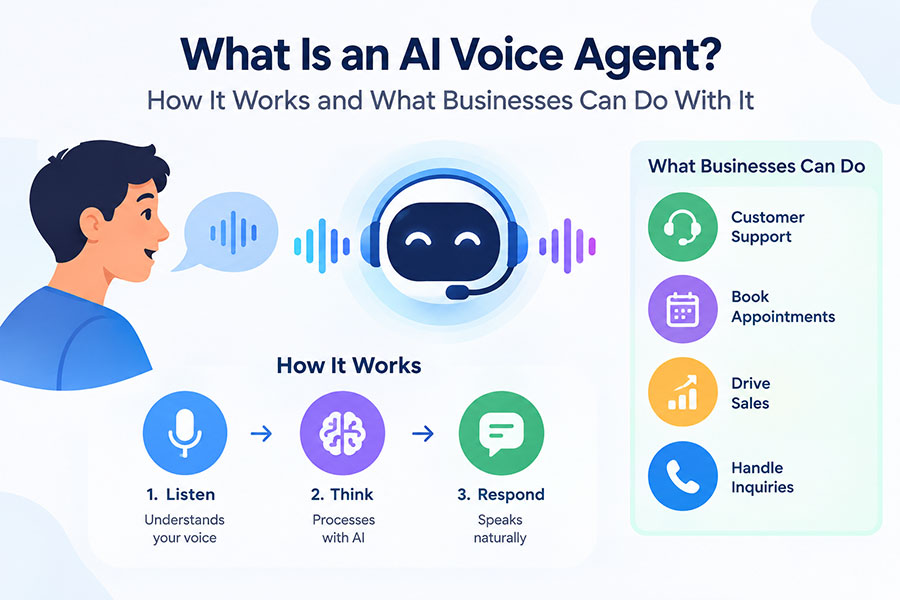
An AI voice agent is software that holds a spoken conversation with a caller, understands what they need, and completes a defined task, rather than reading from a fixed script or waiting for keypad input. It combines speech recognition, natural language understanding, and text-to-speech to hold a conversation that feels closer to talking with a person than navigating an automated system.
At a high level, the process works like this:
Customer speaks → speech recognition converts audio to text → the system interprets intent → an AI model generates a response → voice synthesis turns that response into speech → the customer hears the reply → the system performs a business action → the conversation escalates to a human when needed.
This is different from a simple voicebot that only follows fixed scripts and recognizes a narrow set of keywords. A true AI voice agent maintains context across a conversation, adapts to varied phrasing, and can connect to business systems to actually complete a task, not just answer a question.
Do You Actually Need an AI Voice Agent?
Before comparing platforms, it's worth stepping back and evaluating the underlying problem, not the technology.
Signs an AI voice agent may be useful:
- High inbound call volume
- Repetitive customer questions
- Frequent appointment requests
- A large number of sales enquiries
- Lead follow-up work that's falling behind
- After-hours enquiries going unanswered
- Repetitive outbound calls (reminders, follow-ups)
- Manual call qualification eating into staff time
- Simple, repeatable status enquiries
- High volume of routine, low-complexity interactions
Signs it may not be the right fit, at least not yet:
- Conversations are typically sensitive or emotionally complex
- Interactions involve complex negotiation
- Requests regularly require human judgment calls
- Business rules and workflows aren't clearly defined yet
- Call volume is low enough that automation wouldn't meaningfully reduce workload
- Your customers strongly prefer, or expect, direct human interaction
If most of your calls fall into the second list, an AI voice agent may add complexity without solving a real problem. If most fall into the first, it's worth continuing the evaluation.
Start With the Business Use Case
Technology selection should follow the use case, not the other way around. A few common starting points:
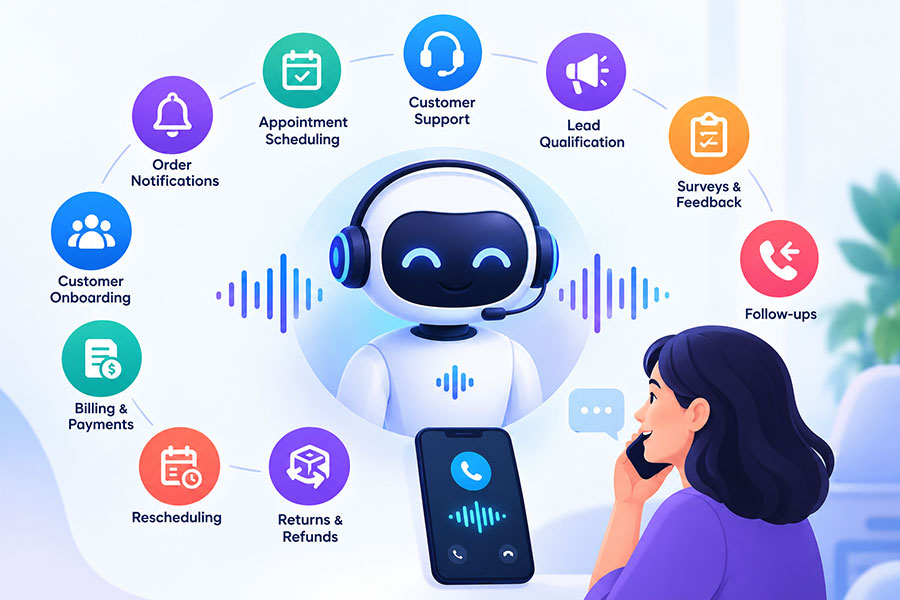
Customer support: answering routine questions, providing information, routing calls, and escalating complex issues.
Sales and lead qualification: asking qualifying questions, capturing requirements, and scheduling sales conversations.
Appointment scheduling: booking, confirming, rescheduling, and cancelling appointments, where the right integrations support these actions.
Follow-ups: automating appropriate customer or lead follow-up sequences.
Order and status enquiries: sharing approved information about orders, appointments, deliveries, or service requests.
Customer feedback: collecting surveys and post-service feedback.
Internal workflows: helping employees retrieve information or kick off internal tasks.
The best first use case is usually specific, measurable, repetitive, and clearly defined:not "automate all our calls."
10 Factors to Consider When Choosing an AI Voice Agent
1. Conversation Quality
Evaluate natural conversation flow, context retention, intent recognition, response quality, and how the system handles unexpected questions. A voice agent shouldn't just spot keywords: it should understand the context of a conversation within its defined workflow, including when it needs to ask a clarifying question rather than guess.
2. Voice Quality and Latency
Assess how natural the voice sounds, pronunciation accuracy, speech clarity, response latency, how interruptions are handled, turn-taking, and performance in noisy environments. Latency matters more than it might seem; a technically capable system can still create a frustrating experience if responses feel delayed or the conversation doesn't flow naturally.
3. Language and Accent Support
Consider English support, regional language requirements, pronunciation, local accents, code-switching (where supported), and your actual customer demographics. For businesses serving Indian customers specifically, language testing should happen using real customer conversations and representative accents: not just a generic demo script. Don't assume a platform supports a specific language or dialect well until you've verified it directly.
4. Business Integrations
Integrations often determine whether an AI voice agent is genuinely useful or just a novelty. Look at CRM, helpdesk, ERP, calendar, e-commerce systems, databases, APIs, webhooks, and authentication systems.
There's a real difference between an AI that can talk about something and an AI that can actually do something. If a caller asks, "What's the status of my appointment?"An agent that gives a generic response is very different from one that securely retrieves the real appointment status from a connected system.
5. Workflow Automation
Check whether the platform can trigger workflows, retrieve information, update records, schedule appointments, create tickets, qualify leads, route calls, send information, call APIs, and escalate conversations appropriately. Workflow flexibility usually matters more in practice than the number of available voice options.
6. Human Handoff
Human escalation isn't optional: it's essential. Evaluate how transfers to a human work, what conditions trigger a transfer, whether conversation context carries over, whether a summary is generated for the receiving agent, routing logic, and fallback handling. A good AI voice system should reliably recognize when it shouldn't continue a conversation on its own.
7. Security and Privacy
Review authentication, access control, encryption, data handling practices, call recording controls, data retention policies, user permissions, the vendor's general security practices, API security, and how sensitive information is treated.
For businesses operating in India, privacy and regulatory requirements should be reviewed according to your specific industry, data flows, customer base, and applicable laws; this varies enough that a general guide can't substitute for that review. Don't assume any vendor is compliant with a specific regulation unless you've verified it through their official, authoritative documentation.
8. Analytics and Monitoring
Look at call transcripts, conversation outcomes, success and failure rates, escalation frequency, abandoned calls, detected customer intent, conversion metrics, and quality-monitoring tools. Analytics matter after deployment because you need to know not just how many calls the AI handled, but whether those conversations actually achieved the business outcome you wanted.
9. Scalability and Reliability
Consider concurrent call capacity, overall volume handling, uptime, infrastructure, response latency under load, failure handling, monitoring, geographic availability, and enterprise-level support. A setup that works fine for a small pilot may need different infrastructure and support once you scale to full deployment.
10. Pricing and Total Cost
Pricing structures can include platform subscriptions, per-minute usage, telephony costs, AI model usage, voice synthesis, speech recognition, phone number rental, concurrent call limits, integration costs, development work, customization, and enterprise support. Compare the complete operating cost, not just the headline subscription price:per-minute rates in particular can look deceptively low until usage scales up.
AI Voice Agent Feature Checklist
| Feature | Why It Matters | Questions to Ask |
|---|
| Natural voice | Customer experience | Does it sound natural to real callers? |
| Low latency | Conversation flow | How quickly does it respond in practice? |
| Context awareness | Better conversations | Can it maintain context across a call? |
| Integrations | Business actions | Can it connect to our CRM/API? |
| Human handoff | Complex situations | Can it transfer calls with full context? |
| Analytics | Optimization | What can we actually measure post-call? |
| Security | Data protection | How is customer data stored and handled? |
| Scalability | Growth | How many concurrent calls can it support? |
| Language support | Customer reach | Which languages and accents are supported? |
| Workflow automation | Business value | What actions can the agent actually perform? |
AI Voice Agent vs. Traditional IVR
| Factor | AI Voice Agent | Traditional IVR |
|---|
| Interaction | Conversational | Menu-based |
| Input | Natural language | Keypad / predefined commands |
| Context | Can maintain conversational context | Usually limited |
| Workflow | Can support dynamic workflows | Mostly predefined |
| Handling varied phrasing | Yes | Usually fixed options only |
| Routing | Can be designed around intent | Menu-based routing |
| Integration | APIs and business systems | Varies by implementation |
| Human handoff | Can be context-aware | Usually a basic transfer |
Traditional IVR still has a place: for simple, well-defined routing where natural conversation adds little value, a basic menu can be faster and cheaper to maintain. The goal isn't to automatically replace IVR everywhere; it's to match the right technology to the workflow.
AI Voice Agent vs. Chatbot
AI voice agent: uses spoken conversation over a phone or voice interface.
AI chatbot: uses text-based interaction through websites, apps, messaging platforms, or other digital channels.
Conversational AI: the broader technology category that can power both voice and text interactions, often sharing the same underlying language model and business logic.
Many businesses end up using voice and chat together, as complementary parts of an omnichannel customer experience rather than choosing one over the other.
How to Compare AI Voice Agents
Rather than ranking vendors, build a neutral evaluation framework based on your own priorities. Common evaluation categories include voice quality, AI conversation quality, workflow capabilities, integrations, language support, human handoff, analytics, security, scalability, customization, developer capabilities, support, and pricing.
Here's an illustrative starting point: adjust it to your business rather than treating it as fixed:
| Evaluation Area | Suggested Importance |
|---|
| Core use-case fit | Very High |
| Integrations | Very High |
| Conversation quality | High |
| Security | High |
| Human handoff | High |
| Language support | Medium–High |
| Analytics | Medium |
| Scalability | Medium–High |
| Pricing | Medium |
| Customization | Medium |
These weightings are illustrative, not universal. A restaurant may prioritize fast order handling and integrations, while an enterprise call center may place greater importance on scalability, analytics, and customization.
AI Voice Agents for Indian Businesses
Businesses serving Indian customers face a few evaluation considerations that don't always come up in generic vendor comparisons: English and regional language requirements, handling of Indian accents, multilingual customer communication, code-switching between languages where supported, high call volumes, sales follow-ups, appointment scheduling, customer support expectations, local business workflows, CRM integration with commonly used regional tools, regional customer expectations, data privacy, security, and telephony infrastructure requirements.
A platform that performs well in one market- say, for US English callers- won't automatically perform the same way for Indian customers speaking in a regional accent or switching between languages mid-sentence. It's worth testing directly against your actual language mix, accents, telephony setup, customer base, and workflows rather than relying on a vendor's general claims. No adoption statistics or market figures are cited here, since reliable, current numbers should come from the vendor or an independent, authoritative source at the time of your evaluation.
Industry-Specific Evaluation
Requirements vary meaningfully by industry:
Real estate: lead qualification, property enquiries, site-visit scheduling, and follow-ups.
Restaurants: reservations, menu questions, orders, delivery enquiries, and customer support, where integrations allow.
Financial services: routine enquiries, reminders, qualification, and support workflows, subject to applicable requirements and appropriate human escalation for anything sensitive.
Retail and e-commerce: order status, returns information, customer questions, and support routing.
Education: admission enquiries, scheduling, reminders, and information requests.
Travel and hospitality: reservations, availability enquiries, booking support, and guest requests.
Logistics: delivery updates, scheduling, customer enquiries, and operational communication.
Each of these requires different conversation design, integrations, security controls, and escalation rules: a one-size-fits-all deployment rarely works well across industries.
AI Voice Agent for Startups vs. Enterprises
| Requirement | Startups & SMBs | Enterprises |
|---|
| Deployment | Faster implementation | More structured implementation |
| Integrations | Core systems | Multiple enterprise systems |
| Scale | Moderate | High |
| Customization | Moderate | Extensive |
| Governance | Basic to advanced | Advanced |
| Analytics | Essential | Advanced |
| Support | Standard | Enterprise-level support |
| Security | Important | Critical |
| Workflow complexity | Usually focused | Often extensive |
| Procurement | Shorter cycle | More structured cycle |
Business size alone shouldn't determine which platform you choose: A small business with complex compliance needs may need enterprise-grade security, while a large company piloting a single simple workflow may not need every advanced feature on day one.
How Much Does an AI Voice Agent Cost?
There is no single standard price for an AI voice agent: costs depend on your specific usage and requirements. Possible pricing components include platform subscription fees, per-minute usage charges, telephony costs, AI model usage, voice synthesis and speech recognition costs, phone number rental, concurrent call allowances, integration work, custom development, and enterprise support.
Because these vary so much between vendors and use cases, this guide won't cite specific figures. Instead, compare the complete operating cost across a realistic usage scenario- not just the advertised headline price- before making a decision.
How to Test an AI Voice Agent Before Buying
A live demo alone isn't enough to evaluate an AI voice agent properly. Consider running these tests, ideally as a structured proof of concept:
Test 1: Normal conversation. Can the AI understand common, expected questions?
Test 2: Unexpected questions. How does it respond when a request falls outside its intended workflow?
Test 3: Interruptions. Can a caller interrupt naturally, the way people do in real conversations?
Test 4: Accents. Test with accents representative of your actual customer base.
Test 5: Background noise. Test in realistic call environments, not just a quiet room.
Test 6:Integration failure. What happens if the CRM or a connected API is temporarily unavailable?
Test 7: Human escalation. Does the AI transfer conversations correctly, with context intact?
Test 8: Incorrect information. How does the system avoid giving unsupported or made-up answers?
Test 9: High call volume. Test concurrency and performance under realistic load, where applicable.
Test 10: Analytics. Can managers actually understand what happened during a batch of calls afterward?
How to Implement an AI Voice Agent
Step 1: Identify the business problem. Start with the workflow, not the technology.
Step 2: Select one use case. For example: lead qualification → CRM update → appointment scheduling → human handoff.
Step 3: Map the conversation. Define intent → response → business action → escalation path.
Step 4: Prepare business knowledge. Define approved information sources and what the AI is allowed to say.
Step 5: Connect business systems. Integrate CRM, calendar, helpdesk, ERP, APIs, databases, and any other required systems.
Step 6: Define guardrails. Specify explicitly what the AI can and cannot say or do.
Step 7: Configure human escalation. Define exactly when conversations should transfer to a person.
Step 8: Test thoroughly. Evaluate accuracy, latency, voice quality, edge cases, interruptions, accents, integration failures, and escalation behavior.
Step 9: Launch gradually. Start with a controlled rollout on a single workflow where possible, rather than switching everything on at once.
Step 10: Monitor and improve. Use conversation analytics and human feedback to refine the system over time.
What Will Matter When Choosing AI Voice Agents in 2027?
It's worth noting a few directions the field seems to be heading, without presenting unverified future capabilities as fact. Businesses may increasingly evaluate more natural conversation quality, better context management across longer interactions, more capable multilingual experiences, lower latency, more sophisticated agentic workflows (where the AI takes multi-step actions), stronger API and enterprise integrations, more advanced analytics, better-designed human-AI collaboration models, deeper omnichannel communication, enterprise-grade governance, and improved personalization.
Platforms are likely to continue evolving in these directions, but specific claims about future capabilities should always be verified with the vendor directly rather than assumed.
Real-World AI Voice Agent Example
Incoming customer call → AI identifies intent → verifies required information → checks CRM → answers the question or performs the action → updates CRM → escalates to a human when necessary.
This is an illustrative workflow, not a claim about any specific company's deployment or results.
Conclusion
Choosing an AI voice agent isn't about finding the platform with the longest feature list:it's about finding the one that reliably fits how your business actually operates. Use-case fit matters more than flash. Voice quality and latency shape whether the experience feels natural or frustrating. Integrations determine whether the AI can actually do something, not just talk about it. Security and privacy protect your customers and your business. Analytics and monitoring tell you whether the system is working, not just whether it's running. And human escalation remains essential:AI voice agents work best as a complement to your team, not a replacement for it.
The right AI voice agent is not necessarily the one with the most features. It is the one that can reliably handle the conversations your customers have, perform the actions your business needs, integrate with your systems, meet your security requirements, and provide a clear path to human support when necessary.
Where Grootvox Fits In
If you're evaluating AI voice agents and need help translating requirements into an actual working system, Grootvox Softwares works with businesses on AI voice agent development, conversational AI, AI chatbot development, customer service and sales automation, CRM integration, API development, enterprise AI solutions, custom software development, AI/ML integration, and business workflow automation.
The typical process looks like this: identify the use case → define requirements → design conversation flows → integrate business systems → establish guardrails → develop → test → deploy → monitor → improve. If you're at the stage of narrowing down requirements or need a technology partner to help build and integrate a solution around your specific workflows, that's a conversation worth having.
 AI Insights